
Yellow House
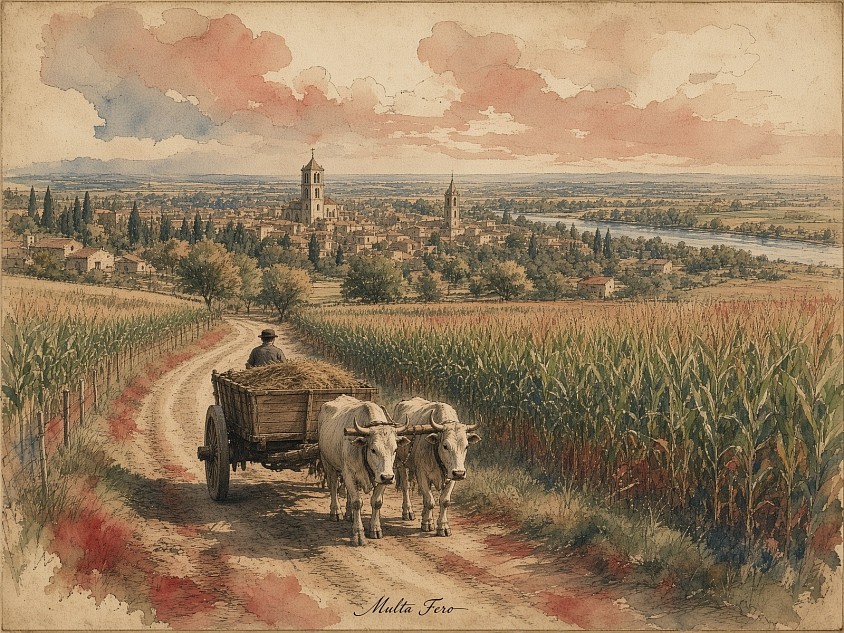
Cornfields, Cart with Oxes, Arles France
1888, Arles France
Snow greets Vincent in Arles on 20 February 1888, sixty centimetres deep across a town no larger than Breda. The cold cuts clean after Paris; coal smoke and frozen earth taste of iron and bitterness. Roman bones still shape the place—the amphitheatre, Saint-Trophime, the Alyscamps—while the railway has quieted the old river port. He has come for cheaper living, for lungs and nerves wrecked by absinthe and smoke, for the southern light he links to Japanese prints, and for the dream of a Studio of the South where isolation might end.
The Hôtel Carrel gives him a cold room that still smells of wax, damp wool and the green fairy’s ghost. He paints at once: an Arlésienne, snow landscapes, a butcher’s shop. Within weeks the snow lifts and the orchards explode. Petals leave green bitterness on the skin. He drives iron pegs into chilled soil against the mistral, which fills the mouth with grit. Chrome yellow, emerald, flake and zinc whites arrive from Theo; he works wet-into-wet on size-30 linen, building impasto so light will catch every ridge. Pink against black branches, the series meant to hang like a Japanese screen. One canvas in four may become a picture; the rest will serve for exchange.
By 1 May the Yellow House at 2 Place Lamartine is his—four rooms, fifteen francs a month. Yellow outside, white inside. He nails recent work to the walls and begins the sunflowers for the guest room that will one day belong to Gauguin. In late August he cuts the heavy heads at first light; peppery sap stains his sleeves. Under the roof heat he loads pure chrome and cadmium in thick, directional strokes. Backgrounds shift from Veronese green to royal blue so the yellow vibrates. Four canvases are finished; the densest hold twelve and fifteen flowers. Yellow becomes the signature of the southern enterprise—friendship made visible, a manifesto in pigment.
September brings the first major night scene: the Café Terrace under stars and gas lamps, warm sulphur against cobalt, no black, only densest blues. Then the Night Café itself, painted by candlelight fixed to his hat. Blood-red against Louis XV green, sulphur against blue-green, figures isolated under artificial light. He calls it one of the ugliest pictures he has made, yet intentional—a place where a man can ruin himself.
Gauguin arrives on 23 October. For sixty-three days they share the house, the meals, the studio. They walk the Alyscamps, argue Delacroix and Rembrandt until their minds feel discharged. Vincent insists the eye must stay honest to the motif; Gauguin claims true art begins only when the eye closes. Rivalry hardens. Absinthe returns. Money worries press. Conversations that once exhilarated now leave Vincent scraped raw. The yellow that once promised welcome begins to accuse.
On the night of 23 December the air inside the house turns metallic. After a heated exchange Gauguin leaves. Vincent follows with an open razor, then turns back. Alone, he cuts off part of his left ear, wraps it, and delivers it to Rachel at the brothel with the calm instruction to keep the object carefully. Police find him the next morning in blood-dark sheets. Theo arrives on the Christmas train. Gauguin leaves with him and never returns.
From the hospital bed Vincent asks what he is getting better for. The shared roof is finished. The yellow remains on the walls, chrome and unyielding, while the mistral combs every ridge. In fifteen months he has produced some two hundred paintings and more than a hundred drawings. The dream of the cooperative studio ends here, yet the light outside the window still falls, indifferent, waiting for whatever answer the living hand can still give.
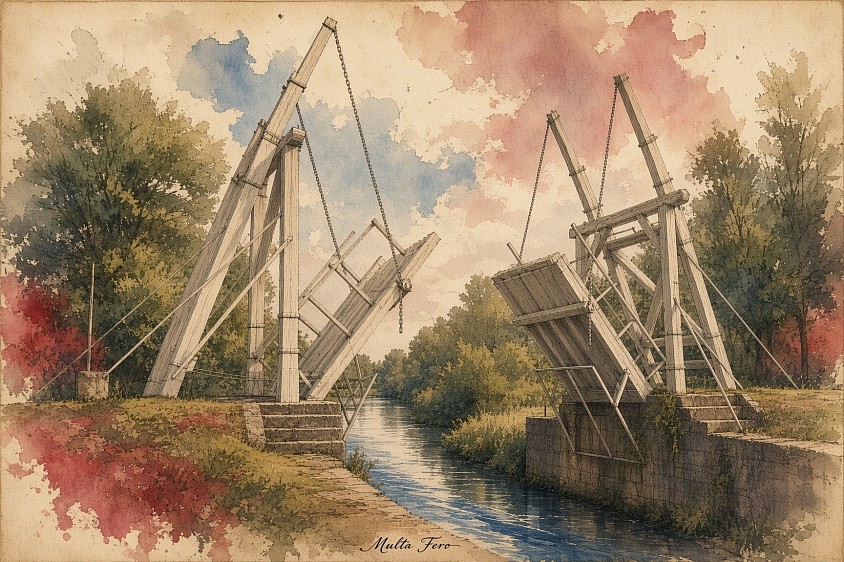
Bridge of Langlois, Arles, France
