
Broken Stroke
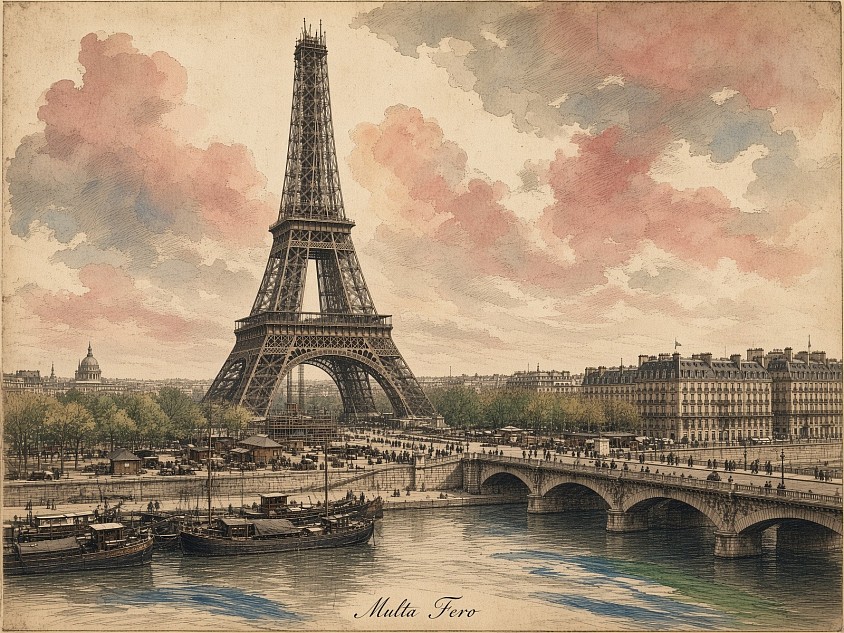
Vincent in Paris
1887, Paris, France
Here is a condensed rendering of the chapter, held to roughly five hundred words while preserving its narrative spine and observer’s voice.
In Paris the Third Republic staggers under successive shocks. The Affaire Schnaebelé of April 1887 nearly ignites war with Germany; General Boulanger rides the resulting nationalist wave until the cautious cast him aside in May. Crowds block the tracks at the Gare de Lyon, chanting his name. Autumn brings the Wilson scandal—traffic in Legion of Honor decorations conducted from the Élysée itself—forcing President Grévy’s resignation in December and the election of colorless Sadi Carnot. Boulangism rises, a strange coalition demanding revision of the constitution. Beyond the hexagon the scramble for continents continues: France consolidates Indochina, the Panama Canal Company lurches toward the bankruptcy that will erupt the following year. Tariffs rise, factories multiply, laborers strike, and absinthe clouds the evenings. Progress marches in iron boots; the human spirit seeks still some fragment of light.
Against this machinery a single Dutchman walks the steep streets of Montmartre. In the winter of 1886 the rooms on the rue Lepic still smell of coal smoke and turpentine. The shared life with Theo is both shelter and attrition. The palette remains heavy with northern earth tones; Japanese prints lean against the walls like unopened letters. He walks at night past the last windmills, feeling the city press inward—a vast organism whose blood is ambition and despair.
At the Café du Tambourin, Agostina Segatori stands behind the zinc counter, her face the color of old parchment. “You came,” she says. The pictures are still there; he tore up the receipt. She is not well—illness, debt, the residual weight of their tangled affection. He leaves the canvases and steps back into the street, the argument unfinished, the affection still lodged like a thorn.
The walks to Asnières begin in earnest. Each morning he descends through abrupt transitions of light and smell until the Seine arrives as sound and mineral scent. There he finds Paul Signac already at work, laying pure dots according to the laws of optical mixture. Vincent answers with longer, directional dashes that keep the vibration while refusing the grid. Émile Bernard appears later, restless between the two languages of color. Thirty, forty pictures grow from these days—bridges, restaurants, the industrial edge held in the same frame as residual green. When the light fails they walk back carrying wet work that leaves accidental prints on their sleeves.
In the late summer he sits again with Père Tanguy. He begins the portrait against a dense wall of Japanese prints, working rapidly in broad, unmodulated planes. “I am becoming a little old man,” he murmurs. “And still I cannot stop.” The desire for wife and children thins each month. Letters to Theo record the attrition and the precise lists of new colors ordered in advance of the south.
By November the Restaurant du Chalet holds the exhibition of the Petit Boulevard. Toulouse-Lautrec pauses before Vincent’s work: “You have made the air move.” In the same months he turns the experimental method upon his own face in the Self-Portrait with Grey Felt Hat, radiating complementary dashes outward from the features. Gauguin arrives from Martinique; the two exchange canvases with few words.
One evening Theo looks up from his accounts. “You’re thinking of leaving.” Vincent stands at the window. “The south has more sun. And fewer painters who fill me with disgust as human beings.” The decision settles without further argument. What 1887 has given—the broken stroke, the high-keyed complements, the memory of the river—will travel with him. What it has taken—the residual strength, the thinning of ordinary desire—will travel also.
In February the train carries him south. The year closes. The work continues.
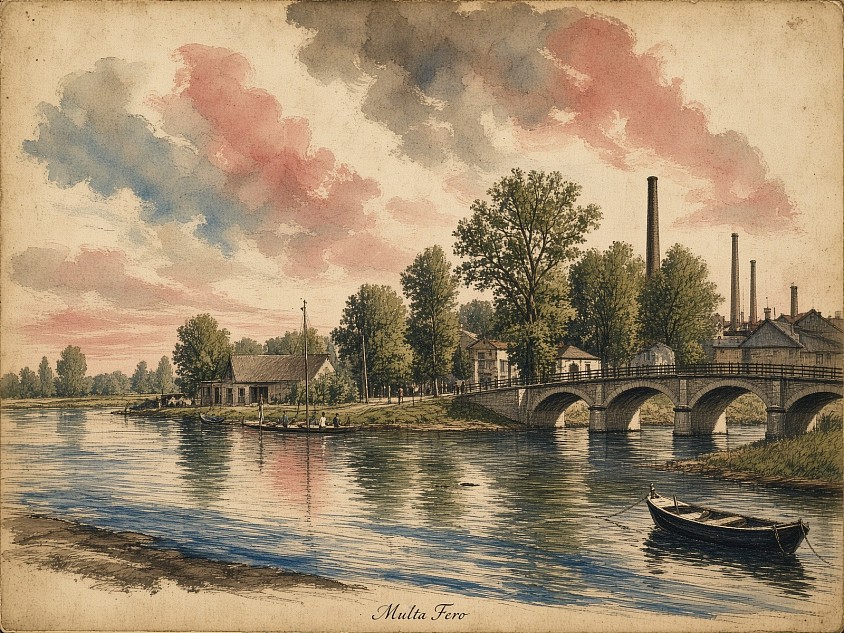
Asnières River
