
Heath Exile
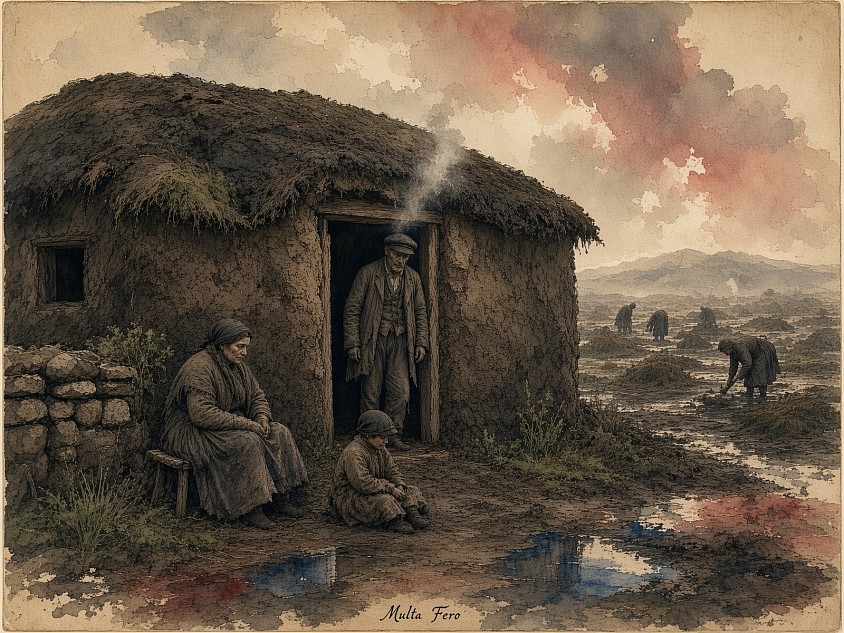
Peat Houses and Workers in Drenthe
1883, Drenthe
Beneath the iron century’s relentless advance, the Eternal Observer traces one soul’s 1883 threshold, where steam and empire grind the many while a solitary painter chooses the charcoal over every softer claim.
Factories multiply like black forests across Europe; colonial tentacles stretch into Tonkin and the Sudan; peat diggers and weavers still cough blood while socialism stirs in beer halls. Within this machinery a man once vowed to the pulpit now stands chained to canvas. In the narrow rooms of the Schenkweg the air reeks of unwashed linen, child’s cough, and mountain chalk. Sien faces him, arms folded, voice rough: the money from Theo is never enough, the children starve, and men like him always leave. Vincent turns the black dust between his fingers and answers that without the drawings the money stops. Inside him the old conflict burns—guilt braided with iron resolve. The Borinage had already killed the preacher; the pencil alone remains honest. He will not coerce and will not abandon, yet the rooms have become a cage. Better exile than slow drowning.
Through spring and summer he peoples the studio with sowers and washerwomen, yet every figure carries the unresolved storm of his heart. Hugo’s pages keep the love of mankind alive when his own spirit threatens to numb. He walks with Breitner among plaster-dusted workmen and answers that he is still with the work; the work does not cough. Alone under the smoking lamp he calculates the few years left and writes that everything lesser must fall away. Only drawings that carry genuine human feeling can answer for the thirty years already lived.
In April the first garden opens; bright hyacinths against sombre earth teach him that colour need not always be buried under labour. By August the letter to Theo seals the mortal struggle between duty and love. On 11 September the train bears him north. Sien and the children accompany him to the last; the girl’s hand is damp, the baby a living warmth. Rain draws lines across the glass. He arrives in Hoogeveen, then moves by barge through the peat to Nieuw-Amsterdam. Loneliness settles heavier than the weather. He paints moss-roofed cottages dark as caves, stacks of peat like drowned houses, women gathering sods against the infinite heath. The palette darkens to ochre, stagnant green, rotting heather. Twenty-five works in three months. The melancholy is healthy, Millet-like. When cold and Theo’s uncertainties close in, he walks six hours back through rain and snow and returns to the Nuenen vicarage on 5 December. The laundry room is cleared for him. The preacher is long dead; the painter remains.
The Brabant winter arrives as verdict. In Helmond his mother’s thigh snaps on the platform with the clean sound of dry bone. Vincent stays, turning her body with liturgical care while Wil performs the harder labour. He paints the small church for her recovery, steeple heavier than brick. Margot Begemann steps into the sewing class; quiet walks deepen until, in September, she collapses from poison in the fields. Family honour closes over the bond like a lid. He turns back to the peasants with renewed ferocity—weathered heads, dark skins, the loom as central emblem of underpaid labour. Earth colours dominate, yet complementary strokes begin to make the darkness vibrate. By year’s end the rented studio holds dozens of those heads and the first large studies of peasants gathered around a dish of potatoes. Nothing higher, nothing cleaner. The year that began with departure ends with the knowledge that the old arrangements cannot continue. The work—sole remaining debt, sole remaining prayer—will continue.
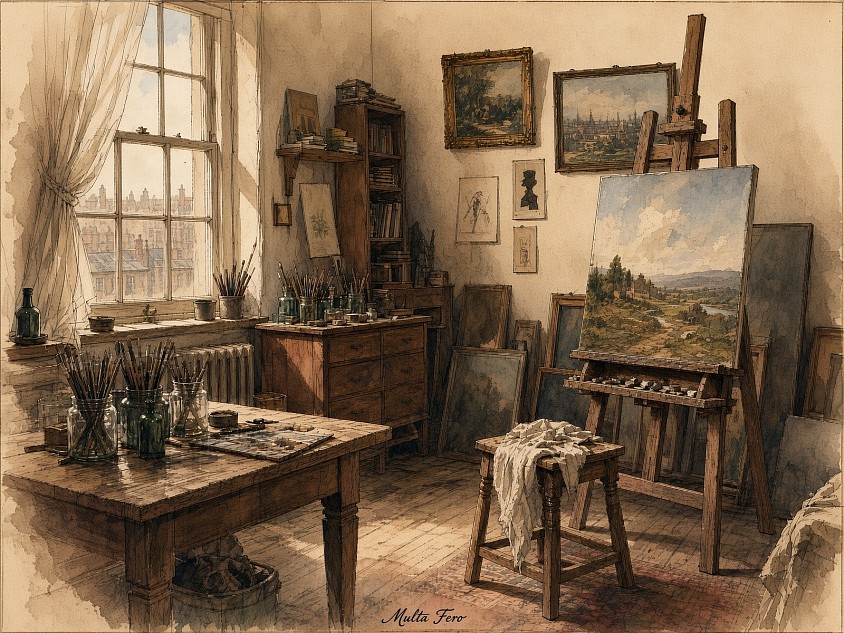
Vincent’s Atelier in Nuenen, Brabant
