
Antwerp Interlude
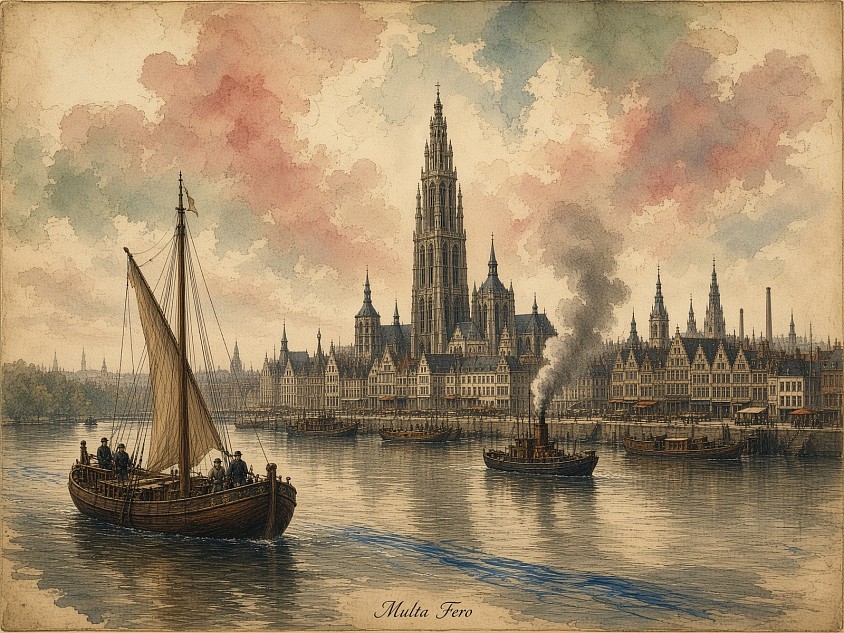
Antwerp seen from the Scheldt River
1886, Antwerp
Antwerp’s docks in early 1886 still reek of tar, coal, and river mist when Vincent first walks them, shoulders bent from earlier black country and peat wastes, seeking in color what the mines and bogs never granted.
Science and capital race forward—electric light, railways, factories reducing men to cogs—yet hunger and outcast despair remain. Art itself shifts: Impressionism spent, newer banners rising. Into this theater steps the Dutch painter, northern darkness still in his lungs, asking whether progress can illuminate the soul.
The Academy rooms smell of charcoal and damp wool. Instructors demand pure contour from plaster casts; Vincent answers with the weight of miners’ shoulders and peasant torsos. Verlat and Siberdt correct him; he refuses. In private he paints a skeleton smoking a cigarette—dark joke against lifeless geometry. Money is short, teeth fail, letters to Theo grow urgent. By late February he boards the train for Paris without waiting.
Theo finds him in the Salle Carrée. They share narrow rooms on the Rue de Laval, then larger ones on the Rue Lepic. At Cormon’s studio Toulouse-Lautrec notes the north still sitting on his shoulder; Bernard asks why so many flowers. Vincent answers that models cost what he lacks, and petals let him practice complementary shocks—blue against orange, red against green—without academic proportion. Japanese prints from the docklands and from Bing teach flat planes and pure intervals. He hangs them, studies them, lets them contradict the Academy’s shading.
Summer multiplies the flower still lifes—more than thirty canvases—laboratories of broken tones and simultaneous contrast. He walks daily to Asnières and the Seine banks, painting bridges, factories, and river light beside Signac and Bernard, wet paint transferring to his smock. The Dutch earth colors are finished; he declares it after the last Impressionist exhibition. Café Le Tambourin receives his Japanese prints and the portrait of Agostina Segatori, lighter palette already cracking the northern manner. Affection fades; the hunger for settled life dwindles.
Even in brighter rooms the earlier works remain judgment: The Potato Eaters with their gnarled hands and dusty-potato tones, the open Bible beside Zola’s novel after the father’s death. Those dark foundations must still answer every new vibration of color. By the turn toward 1888 the northern weight has lifted enough for the south to call.
O reader who has followed the solitary figure from black pits through Antwerp streets and Paris ateliers, the chapter ends but the larger motion continues. Nations arm, capital expands, the poor remain; art alone tries to give form to the soul’s invisible struggle. The complementary pairs he has learned—blue and orange, red and green—are only visible signs of the deeper opposition running through every human destiny. The next light waits farther south.
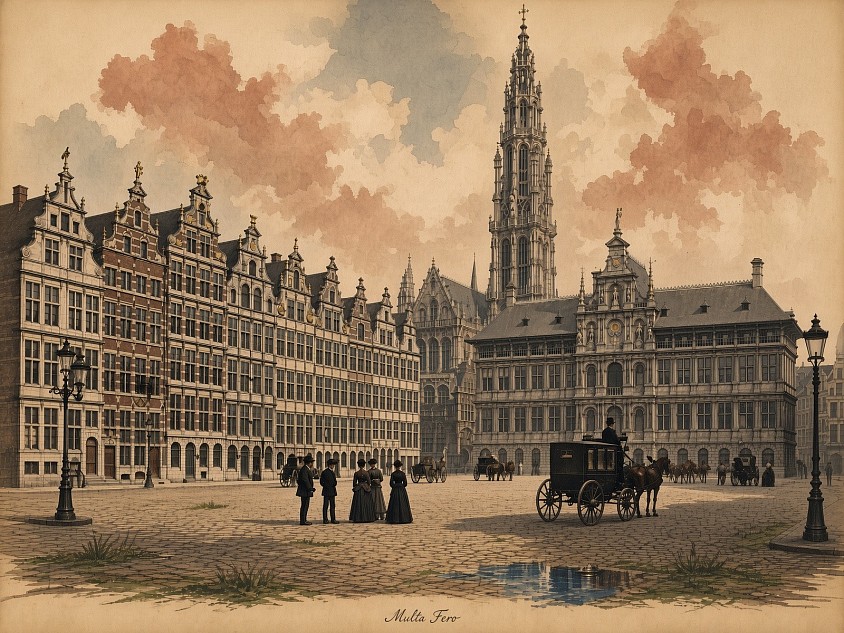
‘Grote Markt’ in Antwerp
