
First Shadows
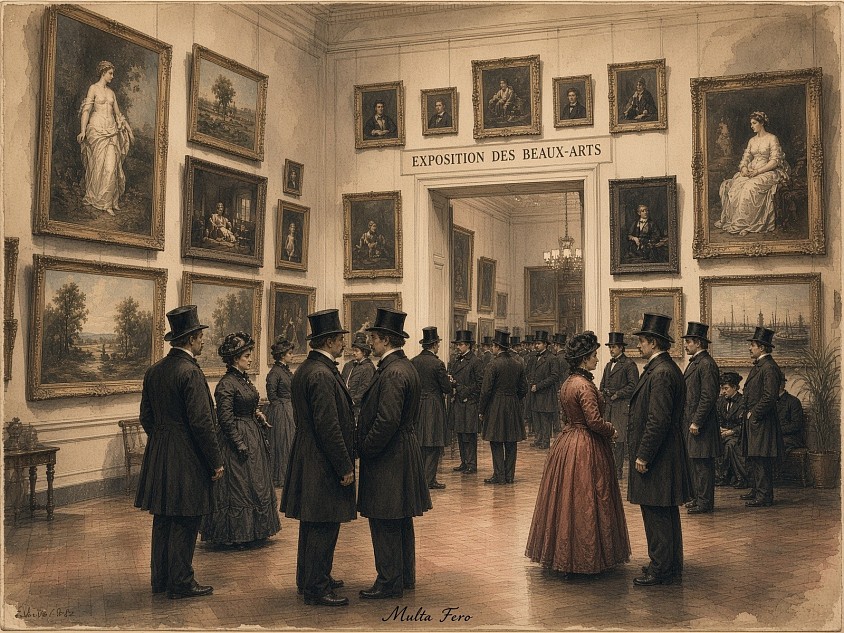
Exhibition
1869-1876
On 30 July 1869 Vincent crosses from Zundert into Goupil & Cie at Plaats 14 in The Hague, the door opened by Uncle Cent’s partnership. Dust films the long warehouse table; frames lean against brick like condemned men. Turpentine and packing straw thicken the air. Manager Tersteeg, waistcoat tight, sets him at the bottom: every canvas has a price, every price must be entered without error. Sentiment has no place. Vincent answers that he understands, yet the monologue rises inside him—they price the light as coal and the coal as light, yet neither holds when night descends. Still the light waits in the crates, and Uncle Cent placed him among the images. What becomes of the eye that learns to see and the heart that learns to price?
Splinters catch his palms; tissue paper whispers over etchings. Tersteeg notes the dreamer’s look and warns that dreams do not pay rent. Vincent replies he will keep both ledger and horizon. The manager’s thought hardens: the boy carries his uncle’s name yet already speaks as if the firm exists to serve private vision. The Eternal Observer marks the contrast of an age—Tersteeg the perfect functionary of the marketplace, Vincent the soft Romantic soul that refuses to measure beauty without diminishing it. Ledger against vision, price against the unpriceable.
By 1870 the seventeen-year-old has become the reliable youngest clerk. He uncrates, wraps, inventories; varnish clings to his clothes like a second skin. Tersteeg’s reports to Zundert are warm. Vincent lodges with the Lange Jacob family and walks the canals whose pewter skies and mud-scented water answer the Hague School canvases passing through his hands—Israëls’ heavy peasants, the Maris brothers’ low grey fields, Mauve’s silvery dunes. He pins Barbizon and Millet prints to his walls until the room becomes a small museum of muted truth. The Franco-Prussian War thins the Paris crates; an older clerk warns that guns are louder than ledgers. Vincent answers that if the crates stop, the light remains. He has begun to claim the faces the firm cannot sell.
In 1871 the family leaves the Zundert vicarage for Helvoirt. Vincent stays in The Hague, still praised, still collecting, still walking the wet earth that confirms the grey painters’ lesson. In August 1872 fifteen-year-old Theo visits. On the paths near Rijswijk the brothers vow to support each other and to choose the light together when the day of choice arrives. Theo’s silent thought is that he will hold the practical thread so Vincent may follow the fire. That autumn Vincent writes his first surviving letter; the correspondence that will number more than six hundred begins. Theo enters the Brussels branch in January 1873. Vincent is transferred to London in June.
At 17 Southampton Street under Charles Obach he trades mainly in reproductions. He lodges first in a quiet neighbourhood with music-loving Germans, then with the Loyer family in Brixton. Galleries enlarge his eye—Millais, Boughton, Turner, Constable—yet his deepest allegiance remains Millet, Breton, Barbizon and the Hague School. He reads Michelet’s L’Amour as gospel. In 1874, after a Helvoirt holiday, he returns with sister Anna and declares his love to Eugénie Loyer. She is already secretly engaged. The refusal is calm, final. The lattice of afternoon light across the polished floor, the scent of lavender and beeswax and coal smoke, the grind of iron wheels outside—all record the quiet closing of a door. Vincent and Anna move to Kennington; Anna soon leaves for Welwyn. Alone, he grows sullen, eccentric, withdrawn. Uncle Cent arranges a posting to Paris; Vincent goes reluctantly in November 1874, returns for Christmas, then is kept on in Montmartre until March 1876.
There the tone of the letters hardens into austere religious counsel. He pins Ruysdael and Rembrandt’s Lecture de la Bible to the walls, visits the Louvre and the Luxembourg, stands awed before Millet drawings at Drouot as before holy ground. Art and the Word become inseparable. In late December 1875 he leaves Paris without permission to spend Christmas at home. The unauthorized absence, joined to his open contempt for the trade, closes the path Uncle Cent once opened.
The apprenticeship of the eye is finished; the apprenticeship of the heart has only begun. The age of iron grinds forward, indifferent. The light, once truly seen, refuses every ledger and will not be carried home in a crate.
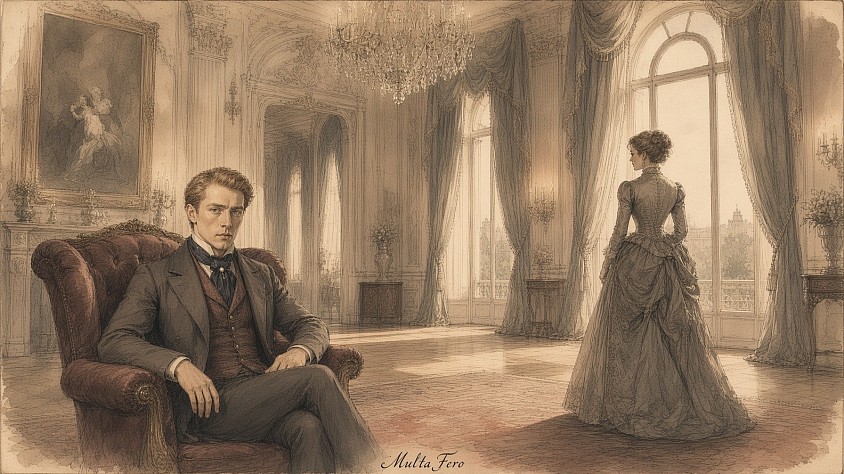
Vincent declaring his love to Eugénie Loyer
