
Failed Vocations
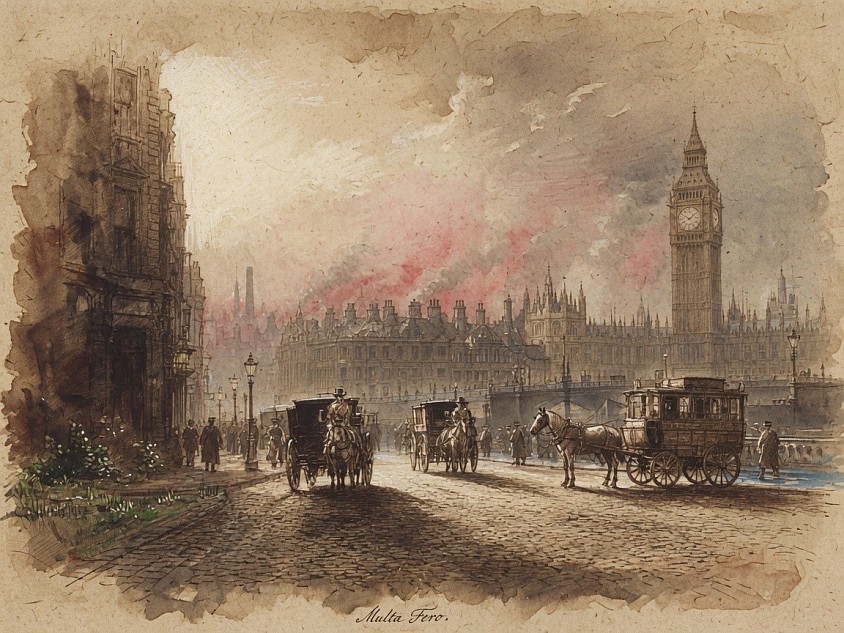
London, Big Ben
1876-1880, London
Along the Thames path on a clear October morning in 1876 the red-haired Dutchman walks with a folded sermon pressed to his coat, chestnut leaves drifting onto the water, and the words already burning in him: I am a stranger on the earth; hide not Thy commandments from me.
In the plain chapel the light falls in slanted shafts through dust. He climbs the creaking steps and speaks of the pilgrim who meets Sorrowful-yet-always-rejoicing and learns the road goes uphill all the way. Outside, Reverend Jones lays a warm hand on his shoulder: “You spoke as one who has already begun the climb.” Vincent answers that he is still learning every step, yet the private vow is colder: from now on, wherever I go, I will preach the gospel—if only the gospel itself remains in the heart.
Christmas at Etten brings pine and woodsmoke and quiet pressure. The English post pays almost nothing; the bookstore in Dordrecht may give him time to think. Behind the counter of Blussé & Van Braam he is an indifferent clerk, translating Scripture beneath the shelves while old walks return—larks over Zundert fields, the cry “Oh Zundert!” rising unbidden. In May 1877 he moves to Amsterdam for Latin and Greek with Mendes da Costa. The dead letters stand between him and the living Word, yet he forces himself through them, writing to Theo by candlelight: In our family someone has always preached the Gospel. Why not now? Why not me?
January 1878. He abandons seven years of preparation. The Flemish Training School at Laeken grants a three-month trial; by October the committee rejects him for excess and unsuitable temperament. He turns south into the Borinage. Snow crusts the black country. He lodges with miners, teaches children for thirty francs, gives away his decent clothes, sleeps on straw, goes barefoot, declares soap a sinful luxury. Coal dust becomes a second skin. He nurses a man burned head to foot by firedamp, sits through nights of olive-oil compresses until the miner walks again. In April he descends seven hundred metres into the Marcasse; the cells are beehives, prisons, tombs. Days later the Agrappe explodes—black dust, orange fire, the stench of burned flesh. He works among the broken without pause. The committee returns in June: zeal has become excess; the appointment is not renewed.
So the Church will not have a man who looks like the men he serves.
He moves to Cuesmes. Theo visits; the brothers walk the black roads. That night Vincent begins to draw the young miner’s ruined shoulders with a tenderness preaching never allowed. Sketchbooks multiply. Millet’s Sower, Diggers, Angelus become mirrors. The same solidarity once sought in the Gospel may be expressed in line and tone. In July 1880, after long silence, he writes Theo of active melancholy, of the great fire that burns while passers-by see only smoke. He walks eighty kilometres to Courrières, loses courage at Jules Breton’s gate, sleeps three nights in the open, returns with the will to draw stronger than before. Brussels follows—Bargue sheets, anatomy, Anthon van Rappard who sees the feeling already under the measuring. April 1881 brings him back to Etten. Kee Vos answers his declaration with three absolute words: Never, no, never. He chooses to keep heart. By December he stands on Mauve’s doorstep in The Hague, sea wind carrying salt and wet rope, and the true beginning opens.
O passerby, the years 1876 to 1880 are not merely one man’s failed vocations; they are the hour in which every old certainty begins to crack. Between the closed door of the Church and the unopened door of the academy a third vocation takes root—in charcoal-stained hands that have walked among the broken and discovered that the broken themselves are the only true scripture left.
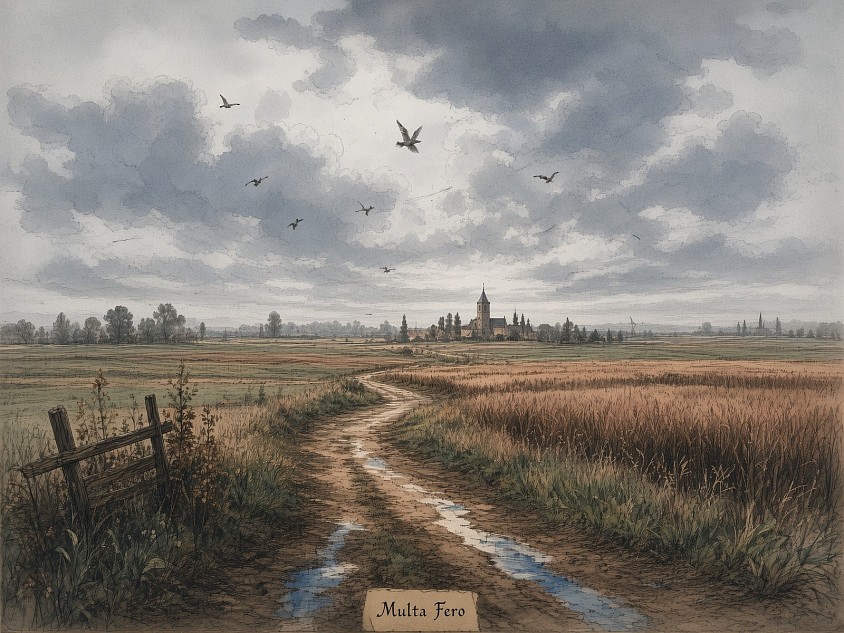
Larks above Brabant Fields of Zundert
